A prompt is a question or an instruction to write against. Prompts live in Prompts in your workspace, free on every account.

Where they come from

Every prompt is filed under one of eight categories: Starting out, Before a session, After a session, Hard days, Relationships, Gratitude, Growth, Rest. Filter by category, or use Search prompts to search the text. Clients can’t publish into the catalogue.
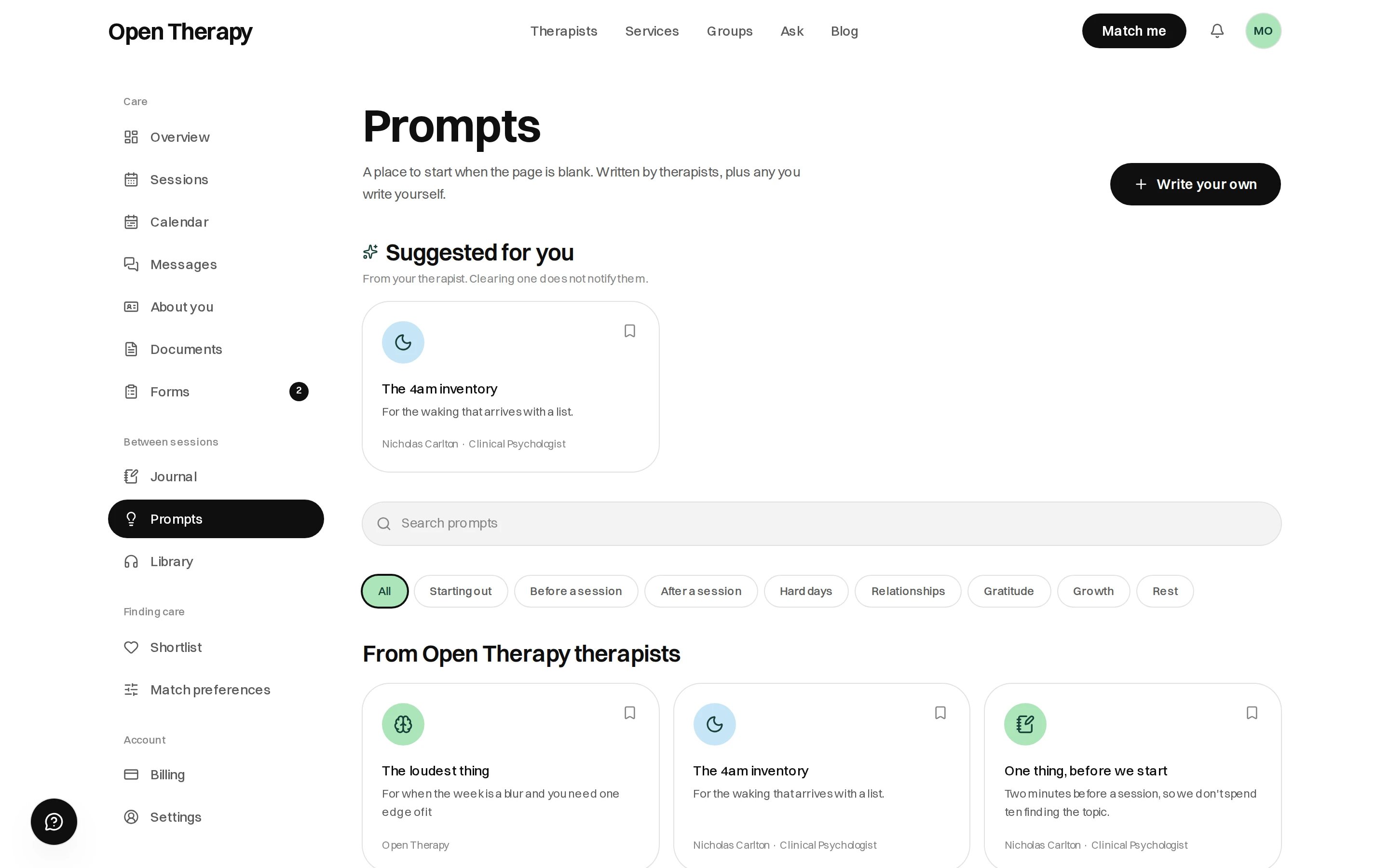
The Prompts page in the workspace with a Write your own button, a Suggested for you card from a clinical psychologist, a search field, category filter pills, and a row of prompt cards under the heading From Open Therapy therapists, each with a bookmark in the corner.

Anything your therapist pointed you at sits above the catalogue, with the categories in between

Saving one

Use the bookmark on a prompt card, or open it and click Save. Saved prompts collect in a Saved section near the top of the page.

When a therapist suggests one

A therapist can suggest a prompt to their client — someone you have or have had a session with. It appears under Suggested for you, marked Suggested by their name, with a note of up to 280 characters if they wrote one. A suggestion is an invitation, not a task. Clearing one from the list doesn’t notify them, and the prompt stays in the catalogue. A therapist can’t suggest a prompt to somebody who isn’t their client. Their side of it is on Prompts.

Turning a prompt into a journal entry

Open a prompt and click Start an entry. The journal opens a new entry with the prompt quoted at the top, and the quote is part of the text, so you can delete it. Nothing records which prompt you started from. Deleting the entry doesn’t touch the prompt, and clearing a suggestion doesn’t touch what you wrote.

What your therapist can see

Nothing here, unless you choose otherwise on a journal entry.

If writing brings something up

Prompts in the Hard days category ask about difficult things. Nobody reads what you write, so writing isn’t a way to reach anyone. If you need help now, Getting help has the crisis lines, or message your therapist.