

The questions
Only the first two are required. Signed out, two more screens sit after those — when you’d like to start, and where to send the list — then the rest.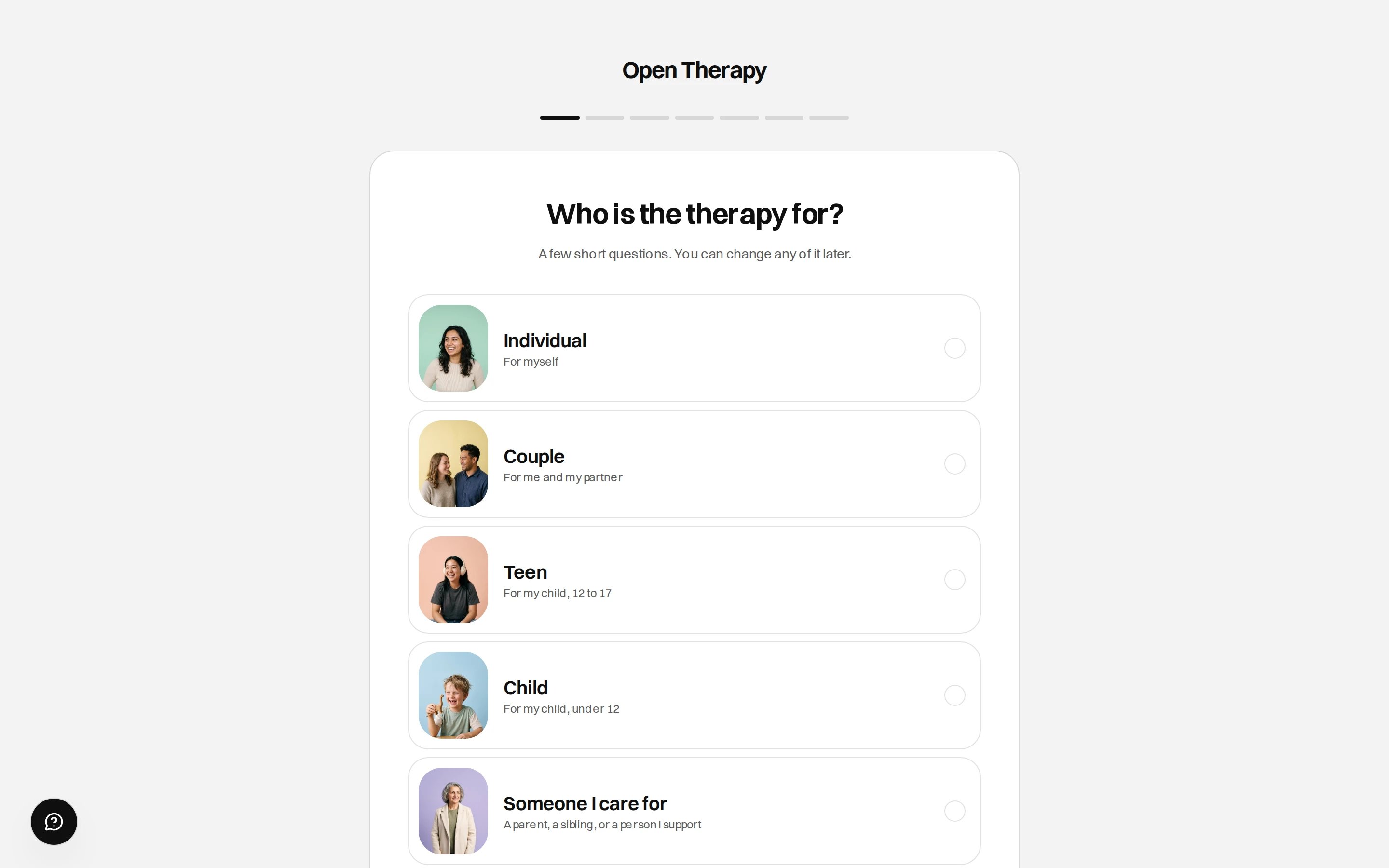
The first question, with your progress marked above the card
1. Who is the therapy for?
1. Who is the therapy for?
One choice: Individual, Couple, Teen (12 to 17), Child (under 12), or Someone I
care for.
2. What brings you here?
2. What brings you here?
As many as fit. This decides which kind of therapist we look at first. Anxiety, low mood, trauma,
focus and ADHD, burnout, relationships, grief, a big life change, parenting, eating and body image,
assessment and diagnosis, daily living and NDIS, speech and language, or Not sure yet.
3. When would you like to start?
3. When would you like to start?
Signed out only, and skippable. As soon as I can, In the next few weeks, In a month or
two, or Just looking for now. Nothing here holds you to a date — it tells us how quickly to
follow up. Signed in, this screen is skipped.
4. Where should we send these?
4. Where should we send these?
Signed out only, and optional. Your matches, so they’re waiting if you don’t finish now. Continue
works with the field empty. The note under the field reads “No account needed. We’ll only send
your matches, and you can opt out anytime.” Signed in, this screen is skipped — your address is
already on file.
5. Anything running through your story?
5. Anything running through your story?
Eight themes: culture and belonging; family; identity, gender and sexuality; neurodivergence,
disability and health; faith and community; work, money and study; parenting, fertility and caring;
loss, harm and survival. None of these skips it.
6. Which of these is the work about?
6. Which of these is the work about?
Only appears if you named a theme, and only shows experiences from the themes you picked. These
are weighted hardest.
7. What would make this easier?
7. What would make this easier?
What you’d like in a person (has lived some of this too, gets my culture without a tutorial,
LGBTQIA+ affirming, neurodiversity-affirming, slow and trauma-informed, direct and practical, warm
and unstructured), their gender, and your preferred language.
8. The practical bits
8. The practical bits
How you’d like to meet (online, in person, home visit), roughly where you are, and how you’ll pay
(Medicare with a GP mental health plan, NDIS, private health extras, or paying yourself). Only
therapists you can see, afford and get to.
How the ranking works
Ask for someone who has lived some of this too or gets my culture without a tutorial, and each shared lived experience is worth two more points again.
Ties break on rating, and anyone scoring nothing is dropped. Gender and funding are scored rather than filtered on, so a therapist who hasn’t answered still appears — the directory’s filters are the strict version.
Working through your matches
Matches arrive five at a time, most-likely first. Show more matches brings the next five. Each card carries up to two reasons — Has lived this, Works with, Speaks or Treats — with the experiences named as chips, falling back to Specialises in. The top card is flagged Closest fit. Shortlist flips to Shortlisted, puts See times beside View profile, and counts in the corner. Nothing turns someone down; scroll past them.Your shortlist
Your shortlist is at /workspace/shortlist, or /shortlist signed out, and from Shortlist in your workspace sidebar. Nobody on it has been contacted.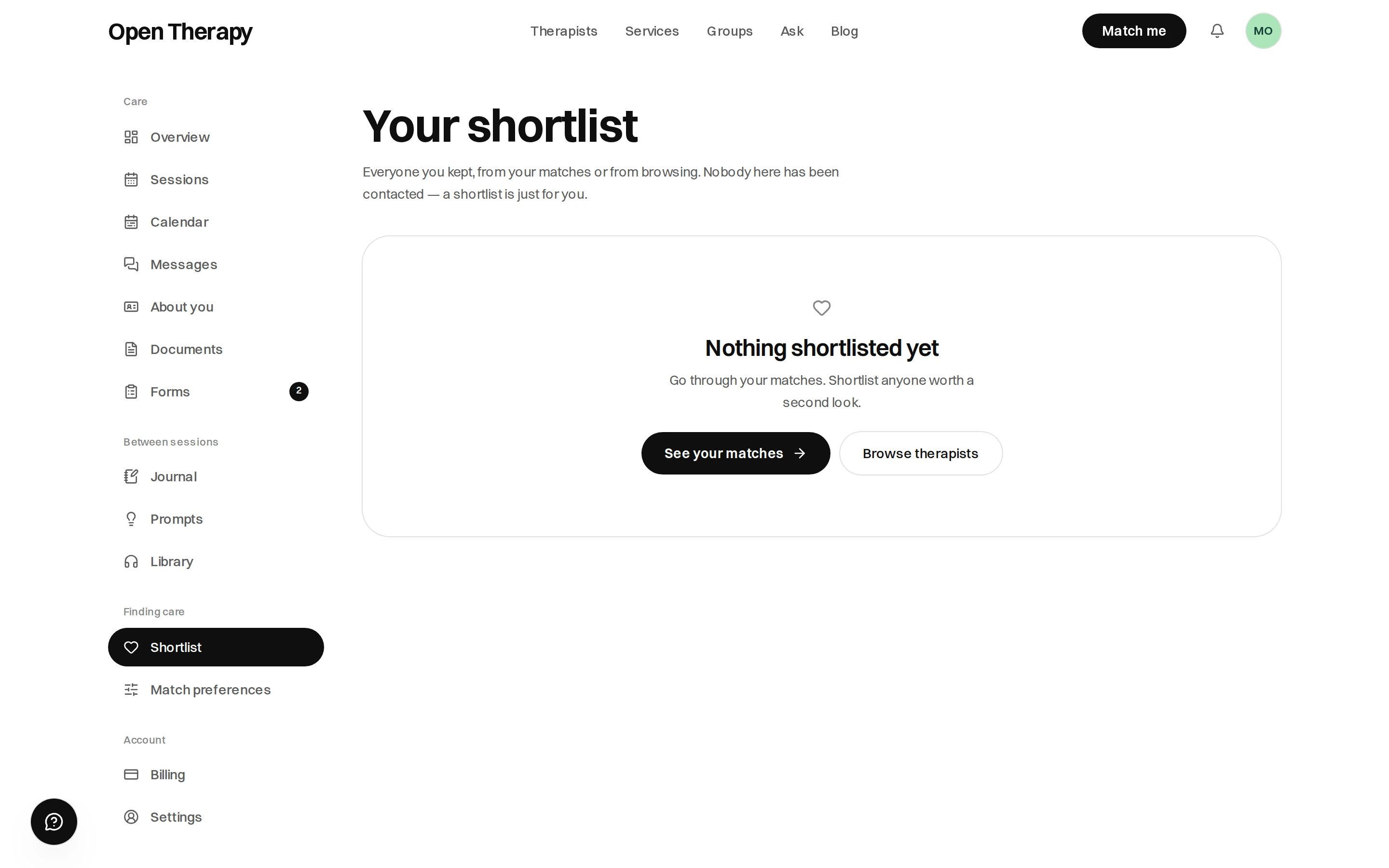
An empty shortlist points you back to your matches or the directory
Changing your answers
Select Change what you’re looking for under your matches, or Match preferences in your workspace, where every question sits on one page. Matches rank fresh each time, so a change applies immediately, and your shortlist isn’t touched.If nothing matches
Widen the search offers the full directory with your answers carried across as filters, or a way back to loosen a couple of answers.Five care types can be booked today — Psychology, Counselling, Social Workers, Mental
Health Support Workers, and Art & Music Therapy. Some concerns point at care types that aren’t
open yet, such as eating and body image (Dietetics) or speech and language (Speech pathology). Those
pages offer a waitlist rather than a directory result. See Care types.
What you get by email
Finishing the questions triggers a Your matches are ready email carrying the reasons the cards show. Stop part-way and you get one reminder that your answers are still there. Neither email tells any therapist anything.Next
Read a profile
What’s on a therapist’s page.
Browse instead
Filter the directory yourself.