

Meet and greet
A short, free online call for someone deciding whether to book. It is on by default. Turn it off, or pick 5 min, 10 min or 15 min, on the same Fees screen. It sits inside an hour you have already published — several can run back to back in that one hour. A meet and greet is always online and always instant, even if your paid services are request-to-book. Someone books it without a card.Without online among your session modes there is nothing to offer, and the switch says so rather
than sitting dead.
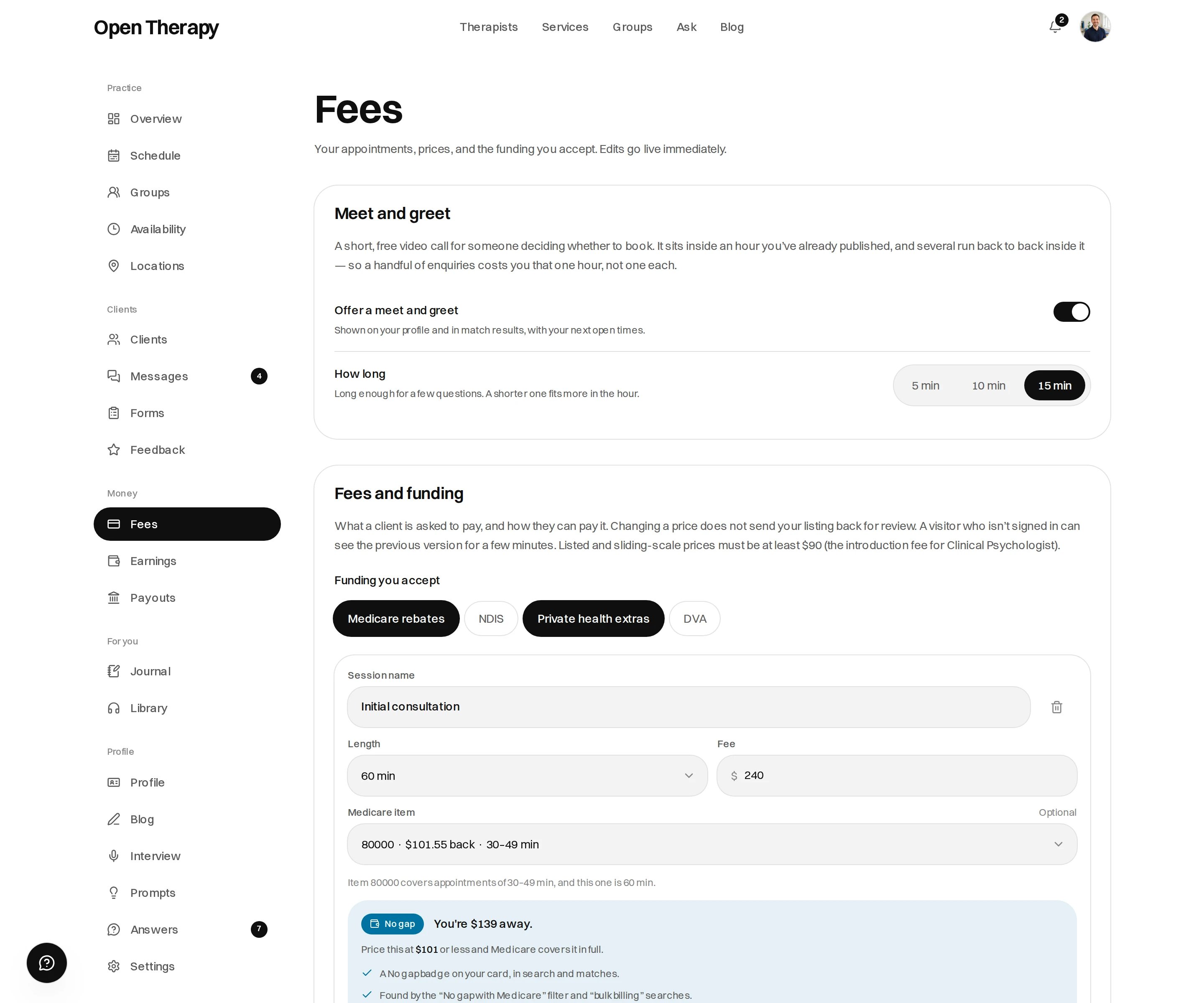
Fees is where appointments, prices and funding live after you're listed
Defining a service
Each service has its own length and price, and you can list up to eight.The price and length are applied from what you’ve set when the booking is priced. The browser can’t
supply an amount. Listed and sliding-scale prices must be at least the introduction fee for your
discipline, so a first session can carry it.
What kind of session it is
An optional What kind of session? question sits under each service, with a short list of chips for your discipline. It decides which service page your session is listed on, alongside everyone else who offers it. Tagging means a client searching for ADHD screening finds your ADHD assessment, and you keep your own wording.- If you don’t answer, we read a tag from the name and say so. Change it and your answer sticks.
- If nothing fits, press None of these fits and tell us what you’d call it. It’s on your profile and in search either way.
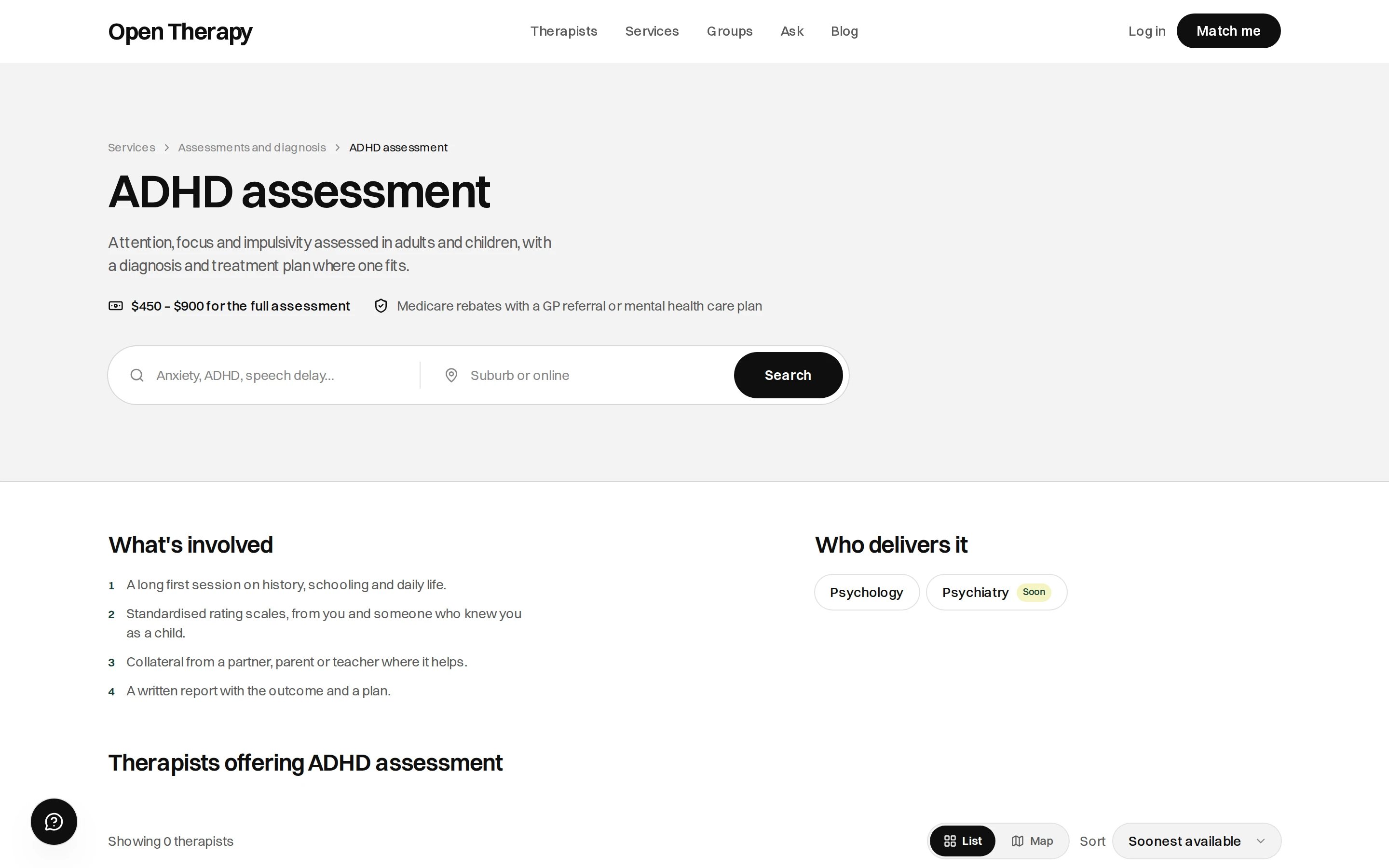
A service page explains the work, what it typically costs and which disciplines deliver it
What clients see in search
Search results show from $X, taken from your cheapest service, with its length. Clients can find you by any session on the list.Directory price filters
A band only ever matches its own unit. The session bands are under $130, $130 – $170, $170 – $220 and $220+. Every session counts, not one nominated as the headline — a therapist whose ongoing hour is $120 answers a filter of under $130 even if their assessment is $600.Your sliding scale
Optional and published: a lower fee for clients on a low income. Set up to three bands, each with a household income ceiling and the fee at or under it. Each service then gets a toggle: Offer this from $90 on my sliding scale. Your profile reads as a ladder — “$90 under $40,000, $130 under $70,000”.Clients tell you which band applies to them when they book, and nothing is checked. A scale also
makes you findable under the Sliding scale funding filter.
Initial consultations
Most practitioners set a separate initial consultation, usually longer and usually higher. The first session with a new client is where the introduction fee lands. See Fees and earnings.Funding you accept
Four chips: Medicare rebates, NDIS, Private health extras and DVA. They appear on your profile under Rebates and funding, as a tick or a dash with a line of detail, and they’re a directory filter.Medicare item numbers
Say you accept Medicare rebates and each service gains an optional Medicare item field. Pick the item you bill rather than typing an amount — we look up the current benefit, so the figure survives the July indexation. The choices are filtered by your discipline and by the length above, so a 50-minute psychology appointment offers only the items it could be. If we don’t hold what you bill, choose Another item number… and enter the item and the rebate yourself.If you keep an item that no longer suits the length, we say so rather than dropping it.
Shift-based support
Support work is priced by the hour across seven rate bands — weekday daytime, weekday evening, weekday night, Saturday, Sunday, public holiday and sleepover — with its own directory filters of Under $80 / hour and $80+ / hour. Clients engage you through a request rather than a booking, and you invoice after each shift.Shift pricing isn’t part of the practice setup yet, so rate bands and rosters can’t be entered there.
If you work shifts, get in touch at support@opentherapy.app.
Changing your prices
Change them whenever you like. New prices apply to new bookings, and a session already booked keeps the price it was booked at.Next
Availability
Publish the hours clients can book.
Fees and earnings
What comes out, and what lands in your account.