

Why reviews here look different
Section 133 of the Health Practitioner Regulation National Law prohibits using testimonials to advertise a regulated health service. A review Open Therapy publishes on your profile is our advertising of your service — and yours. The line the law draws is clinical content. A review may describe the service, but not the treatment.This cuts both ways: a review can’t say therapy helped, and it can’t say it didn’t.
Screening
Nothing reaches a profile until it has been screened: a word list, then a model that reads the review against the boundary above. A review is published only when both stages agree it’s clean. Every other path leaves it unpublished — a clinical verdict, an unclear verdict, a word-list hit the model didn’t see, a malformed response, an unreachable model, screening not being configured at all. There is no path that publishes on a timeout.
The reason a review is held or rejected is recorded as one or more of: mentions a symptom, condition or diagnosis; describes treatment, technique or medication; describes a clinical outcome or improvement; recommends the practitioner for a clinical need.
Implication counts. “I can finally sleep through the night” is an outcome even though it names no diagnosis.
The word list is blunt and is not the decider. It catches roughly one clinical mention in ten. A hit on its own never publishes and never rejects — it sends the review to a person.
Screening is built and running, but the client-facing way to write a review isn’t live yet. Review
writing is being rolled out — until it is, no new review can be submitted against your profile.
What you can’t do
Screening is Open Therapy’s responsibility and is applied identically for everyone. Published reviews appear under Feedback in your workspace, next to any private session notes. When one is published you’re also told — “You’ve got a new review”, with the star rating — and a link to your public profile.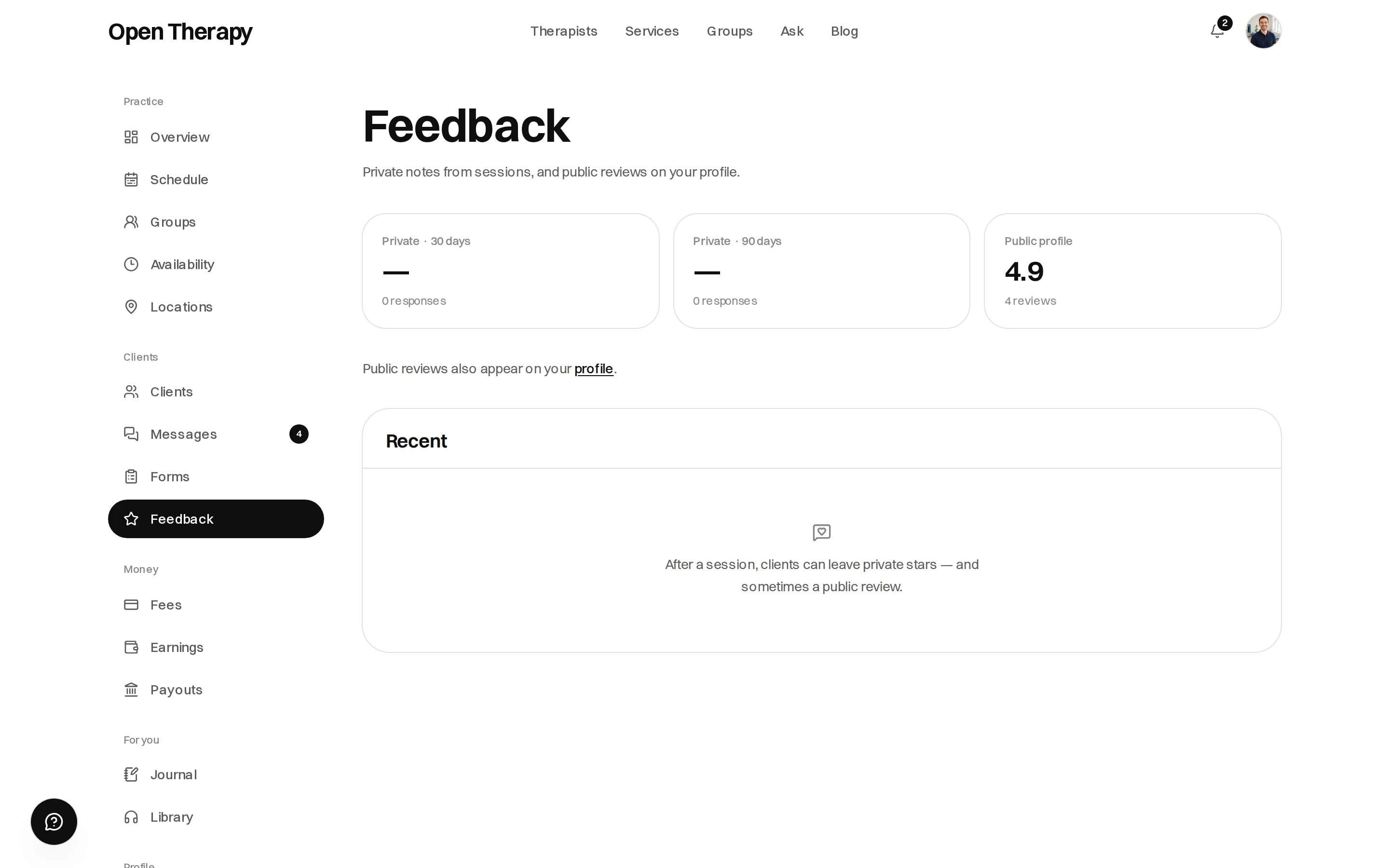
Feedback lists your public rating, and any private notes from sessions