

The four presets
Flexible
Flexible
“Half a day’s notice and no fee. Suits short-notice and first-time bookings.”
Standard
Standard
“A day’s notice, then half the fee. What most therapists here use.” The default.
Firm
Firm
“Two days’ notice, then half the fee. For a diary that’s hard to refill.”
Strict
Strict
“Two days’ notice, then the full fee. The strictest we’ll enforce.”
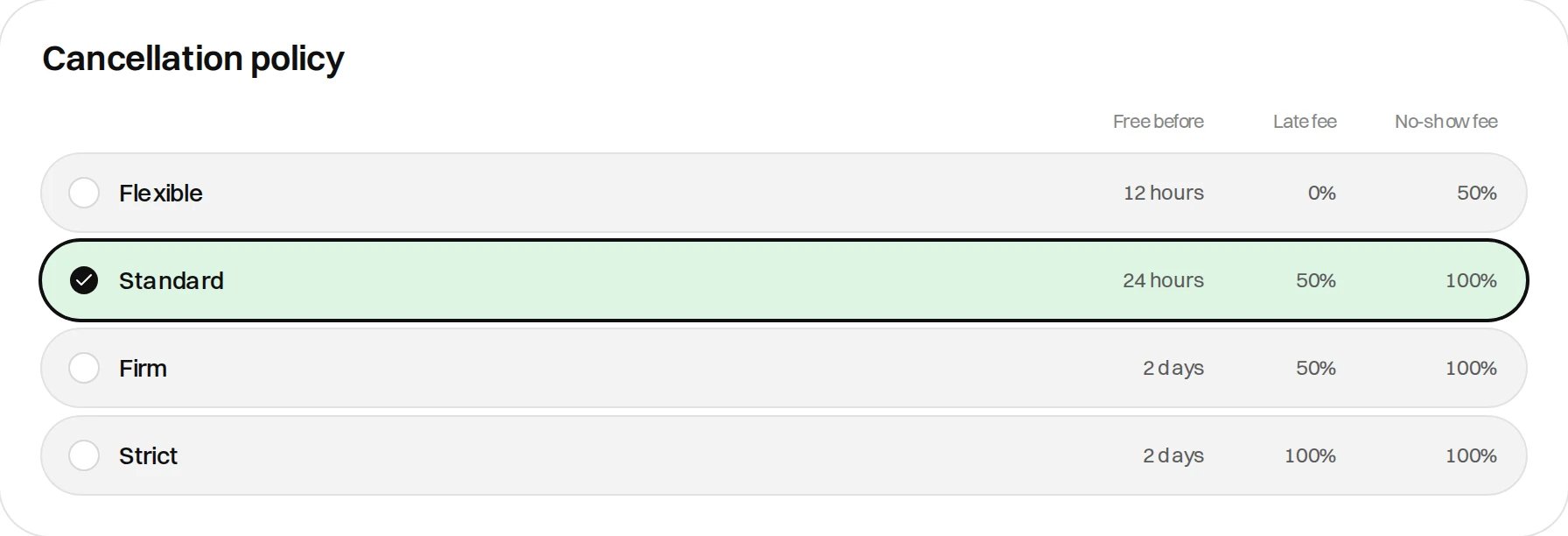
The rates under each name are the ones a client is quoted
Choose one before you take bookings
Terms are copied onto each session as it’s booked. A change applies to new bookings only, and a session already in the diary keeps the terms it was booked under.Three rules that aren’t yours to set
You never charge for your own cancellation
If you cancel, the client is refunded in full regardless of notice.
Cancelling after the start time is a no-show
A client who cancels once the session was due to begin pays the no-show rate, not the late rate.
The boundary itself is free
Notice is measured as “at least”. Exactly 24 hours before a Standard session costs nothing.
Rescheduling
Moving a session is free, with no cap on the number of moves. The notice a client needs is: max(your reschedule notice, the free-cancellation window of the policy the session was booked under)
Inside the threshold the hour can’t be moved, only cancelled: “Moving needs 24 hours notice. You can still cancel, under your therapist’s policy.”
A session that was due to start can’t be moved at all — “This session was due to start, so it can’t be moved.”
You can always move your own appointment, whatever the notice.
What the client sees
The wording is generated from the terms in force. On Standard, a client reads three rows:
On Flexible they read two:
In one line: Standard is “Free cancellation up to 24 hours before. Inside that, 50% of the fee, and the full fee for a session you don’t attend.”, Flexible “Cancel whenever you need to, no fee. A missed session is charged at 50%.”
Before confirming, a client is told the exact amount — “$90.00 late cancellation fee. The remaining $90.00 goes back on your card.” They can also give a reason, up to 500 characters, which reaches you.
What you receive
A cancellation fee settles like any other earning: the fee becomes the gross. Card processing is not taken from that — you keep the retained session fee. The client paid the session plus card processing, so a refund includes a matching share of that surcharge. The dialog quotes the session amounts — “$90.00 late cancellation fee. The remaining $90.00 goes back on your card.” — and the card is then credited the session remainder plus its share of processing.Worked example
A $180.00 session on Standard, returning client, cancelled with five hours’ notice. The client paid $183.42. The fee is 50% of $180.00, so $90.00 is retained. $91.71 goes back on the card ($90.00 of the session plus $1.71 of the surcharge). That $90.00 settles as its own gross:
With no notice, or a no-show, the full session fee applies and you receive $180.00.
Those figures assume a returning client, so no introduction fee. On a client’s first settled session
the introduction fee comes off too, clamped so your payout can’t go below zero. See
Fees and earnings.