> ## Documentation Index
> Fetch the complete documentation index at: https://docs.opentherapy.app/llms.txt
> Use this file to discover all available pages before exploring further.
# Forms and measures
> Sending measures and your own forms, how answers come back scored, and what you see.
**Forms** in your workspace sends questionnaires and collects the answers on the client's record already scored.
## The library
Ten scored instruments ship with the platform, reproduced as published.
| Measure | What it covers |
| ------------- | ---------------------------------------------------------------------------------- |
| **PHQ-9** | Depression severity over the last two weeks. Nine items, out of 27 |
| **GAD-7** | Anxiety severity over the last two weeks. Seven items, out of 21 |
| **K10** | General psychological distress over the last 30 days. Ten items, 10 to 50 |
| **DASS-21** | Depression, anxiety and stress as three separate scores. Each subscale out of 42 |
| **WHO-5** | Subjective wellbeing over the last two weeks. Five items, reported as a percentage |
| **PCL-5** | Post-traumatic stress symptoms over the last month. Twenty items, out of 80 |
| **EPDS** | Perinatal depression over the last seven days. Ten items, out of 30 |
| **AUDIT-C** | Three questions on how much and how often. Out of 12 |
| **ASRS v1.1** | The six-question ADHD screen |
| **PHQ-2** | The two-item depression screen |
Filter by category or search by name. Each carries its attribution.
Measures are not editable. Changing an item invalidates the norms it was validated against. If you
want something of your own, write a form.
### Licensed instruments are deliberately absent
The Beck inventories, the Y-BOCS, the ORS and the SRS are not in the library and won't be: every instrument here is free to use in clinical practice. Reproduce anything you're licensed for as a custom form under your own licence.
## Scoring comes from the registry
You never type a score in, and neither does the client. The instrument turns answers into a score, a severity band and, where it defines one, a risk flag. One definition per instrument means a chart across four months compares like with like. Direction is part of the definition: a falling PHQ-9 and a rising WHO-5 are both drawn as improvement.
Open Therapy scores an instrument. It does not interpret one, and nothing on the platform tells you
what to do about a score.
## Your own forms
**New form** opens the builder. Questions can be scales, single or multiple choice, short or long text, a number, a date, a yes/no, or a section heading.
Five editable starting points sit in the library: **Intake questionnaire**, **Consent to treatment**, **Telehealth consent**, **Safety plan** and **Session feedback**. Copying one gives you a draft of your own. Publish a form before you send it.
## Sending one
From the measures library, your own forms, or the client's file.
Only clients with an account can be sent a form — see [Client files](/therapists/client-files).
**Once**, **weekly**, **fortnightly**, **monthly** or **quarterly**. Fortnightly is the default.
A start date, and an optional end date. A repeating assignment runs until you end it, to a
ceiling of 260 occurrences.
Up to 1,000 characters, shown to the client with the form.
An occurrence stays **due** for the whole period it belongs to and becomes **overdue** only when the next one arrives. A one-off form has a week's grace. Answers are matched to the occurrence they were due for, not the day they were submitted.
### Due dates don't move with the reader
Almost every date on Open Therapy renders in the reader's timezone. Form due dates stay on the portal's timezone for both of you.
## Reading what comes back
**Out with clients** lists live assignments. Anything with a flagged response — a self-harm item, or a risk question answered high — is pulled to the top of the page under **Needs a look**.
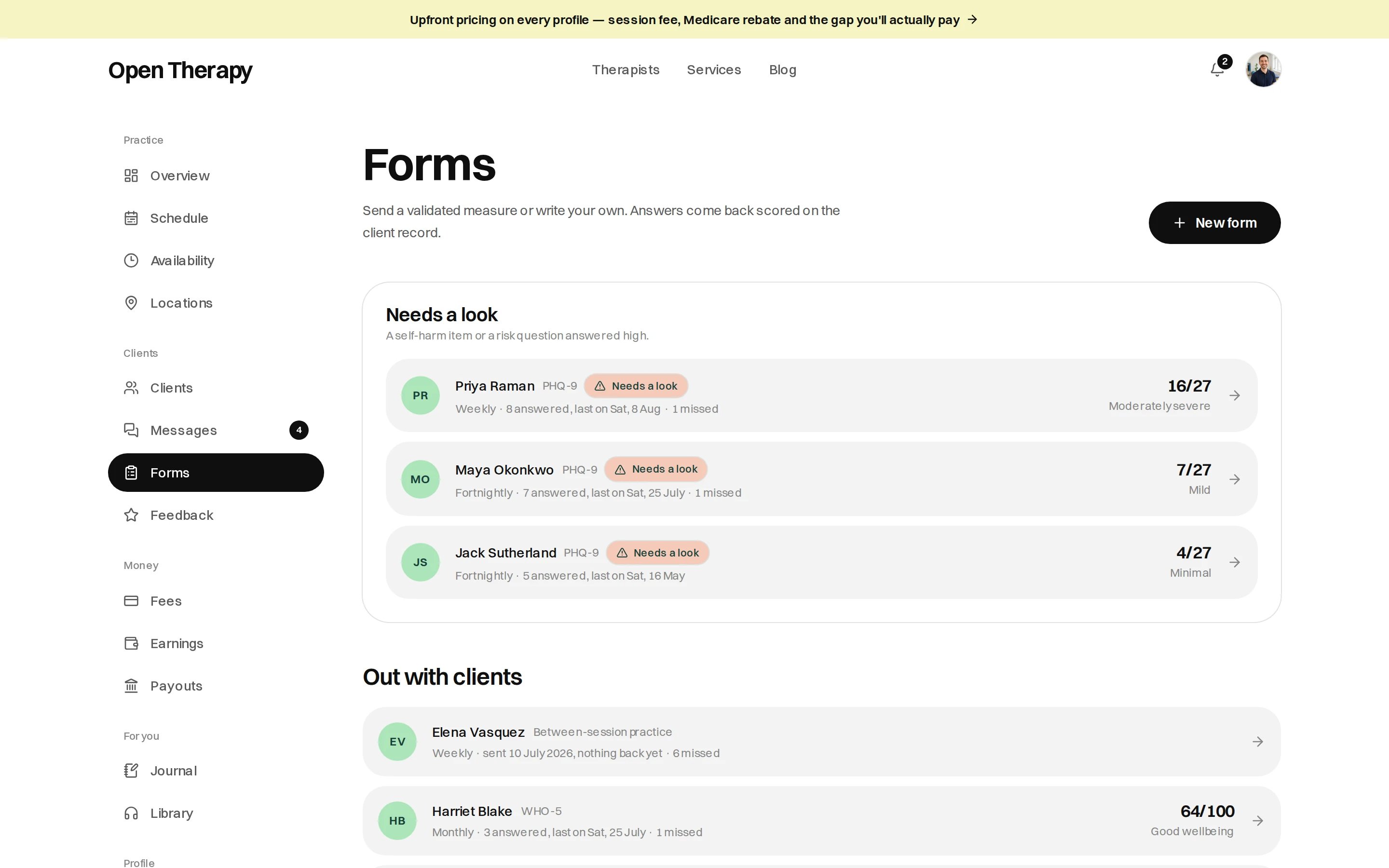 A returned form appears on the client's **Measures** tab with the score, the change since last time, the severity band, the individual answers and a trend line. You're notified when one comes back, a flagged response differently to a plain completion, and that notification can't be muted.
A flag is a prompt to read the answers, not an alert anyone else receives. Open Therapy does not
monitor responses and does not provide crisis support. If someone is at immediate risk, call 000.
Lifeline is 13 11 14. See [Getting help](/getting-help).
## The client's sharing switch
Clients control what their therapists see. **Outcome measures** is described to them as *"Your treating therapists see the same K10 and GAD-7 scores you do."* It **defaults on**.
If a client turns it off:
| | |
| ------------------------ | ---------------------------------------------------------------- |
| You still see | That you sent the form, and that they answered |
| You don't see | The score, the severity band, the answers, or the risk flag |
| The notification becomes | A plain completion, with no indication that anything was flagged |
You can ask a client to turn it back on. You can't turn it on for them, and you won't be told when it changes.
A returned form appears on the client's **Measures** tab with the score, the change since last time, the severity band, the individual answers and a trend line. You're notified when one comes back, a flagged response differently to a plain completion, and that notification can't be muted.
A flag is a prompt to read the answers, not an alert anyone else receives. Open Therapy does not
monitor responses and does not provide crisis support. If someone is at immediate risk, call 000.
Lifeline is 13 11 14. See [Getting help](/getting-help).
## The client's sharing switch
Clients control what their therapists see. **Outcome measures** is described to them as *"Your treating therapists see the same K10 and GAD-7 scores you do."* It **defaults on**.
If a client turns it off:
| | |
| ------------------------ | ---------------------------------------------------------------- |
| You still see | That you sent the form, and that they answered |
| You don't see | The score, the severity band, the answers, or the risk flag |
| The notification becomes | A plain completion, with no indication that anything was flagged |
You can ask a client to turn it back on. You can't turn it on for them, and you won't be told when it changes.