> ## Documentation Index
> Fetch the complete documentation index at: https://docs.opentherapy.app/llms.txt
> Use this file to discover all available pages before exploring further.
# Answering questions
> How a question reaches you, how answers are screened, and the line between information and advice.
Ask a therapist is being rolled out. The public library and the **Answers** queue in your
workspace are not on for everyone yet.
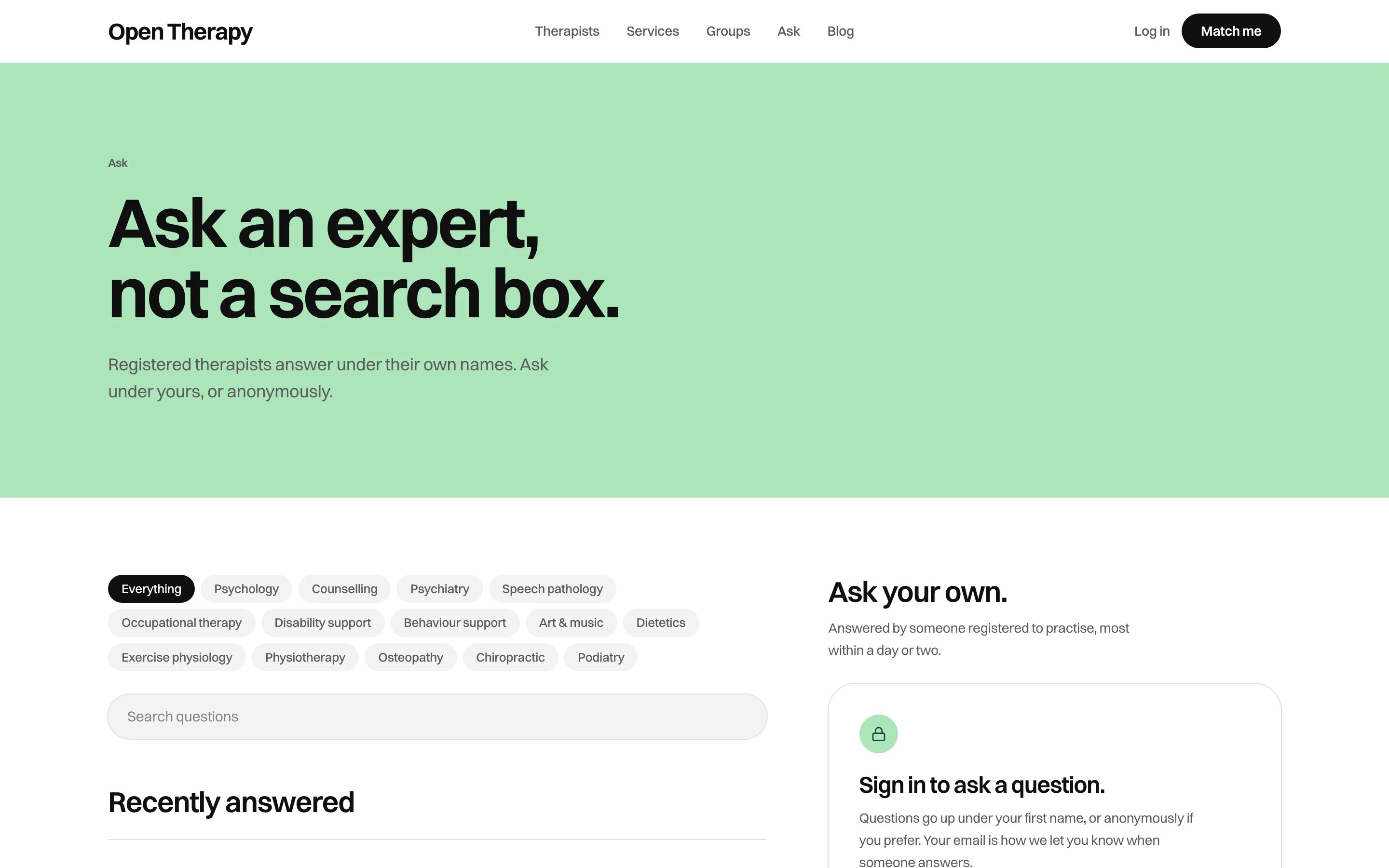
**Ask a therapist** is a public question-and-answer library at `/ask`. Anyone can ask; published therapists answer under their name and discipline. **Answers** in your workspace is your queue.
 ## How a question reaches you
A topic, a title of at least 15 characters, up to 2,000 characters of detail. Under their first
name or anonymously.
Two checks run before a question exists publicly. A crisis is answered with crisis lines rather
than filed. Anything else borderline waits for a person to read.
Chosen by discipline, from the care category the asker picked. Only published, unbanned profiles.
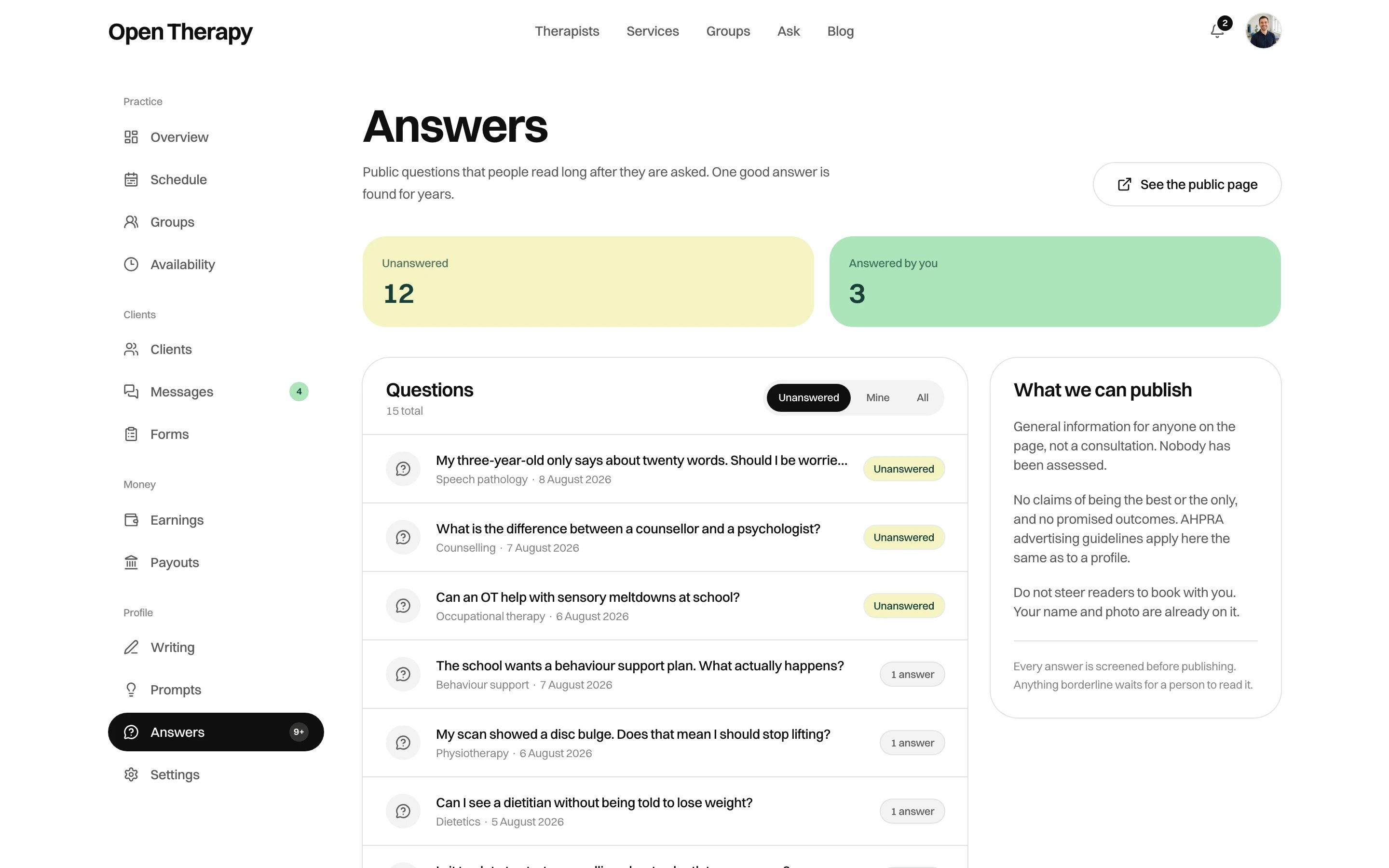
Every published question in your disciplines sits at the top of **Answers**, emailed or not.
## The topics are care categories
The topic picker offers **every care category, including the ones marked coming soon**. `/ask/topic/psychology` and `/care/psychology` mean the same thing. So you may see questions in categories that aren't open for booking yet — the answer outlives the launch.
## Answering
Filter your queue by **Unanswered**, **Mine** or **All**. Two cards count what's waiting and what you've published. An answer is between 80 and 4,000 characters, and you can read the answers already published on the question before writing yours.
## How a question reaches you
A topic, a title of at least 15 characters, up to 2,000 characters of detail. Under their first
name or anonymously.
Two checks run before a question exists publicly. A crisis is answered with crisis lines rather
than filed. Anything else borderline waits for a person to read.
Chosen by discipline, from the care category the asker picked. Only published, unbanned profiles.
Every published question in your disciplines sits at the top of **Answers**, emailed or not.
## The topics are care categories
The topic picker offers **every care category, including the ones marked coming soon**. `/ask/topic/psychology` and `/care/psychology` mean the same thing. So you may see questions in categories that aren't open for booking yet — the answer outlives the launch.
## Answering
Filter your queue by **Unanswered**, **Mine** or **All**. Two cards count what's waiting and what you've published. An answer is between 80 and 4,000 characters, and you can read the answers already published on the question before writing yours.
 Nothing is assigned or reserved — you can answer any published question. Saving your answer again replaces it and sends it back through screening.
Your profile has to be published before an answer can be.
## Screening before publication
Every answer is screened before it appears. Anything borderline shows in your queue as **In review** until a person reads it.
| | |
| ------------------------------- | --------------------------------------- |
| **Published** | Live on the public page within a minute |
| **Posted, waiting on a review** | Held for a person to read |
| **Rejected** | Not published, with the reason |
There's no appeal queue and no way to push something through. Rewrite and post again.
## Answers are public, indexed and attributed
An answer carries your name, discipline and photo, and links back to your profile. It's a public web page, found by search.
## General information, not advice
You have not assessed anyone. Write for the reader who finds this from a search in two years, not for the person who asked.
| Do | Don't |
| --------------------------------------------------- | -------------------------------- |
| Explain how something generally works | Tell the asker what they have |
| Describe what an assessment usually involves | Recommend a treatment for them |
| Say what would usually prompt seeing someone | Comment on their medication |
| Say plainly what you can't answer without assessing | Imply you're now their clinician |
Answering a question does not create a therapeutic relationship, and Open Therapy does not provide
clinical care or crisis support. If a question describes someone at risk, the answer is emergency
services on 000 and Lifeline on 13 11 14. See [Getting help](/getting-help).
Nothing you write is a client record. Don't describe a client, even without a name — the advertising and identifiability limits in [Writing](/therapists/writing) apply here too.
Nothing is assigned or reserved — you can answer any published question. Saving your answer again replaces it and sends it back through screening.
Your profile has to be published before an answer can be.
## Screening before publication
Every answer is screened before it appears. Anything borderline shows in your queue as **In review** until a person reads it.
| | |
| ------------------------------- | --------------------------------------- |
| **Published** | Live on the public page within a minute |
| **Posted, waiting on a review** | Held for a person to read |
| **Rejected** | Not published, with the reason |
There's no appeal queue and no way to push something through. Rewrite and post again.
## Answers are public, indexed and attributed
An answer carries your name, discipline and photo, and links back to your profile. It's a public web page, found by search.
## General information, not advice
You have not assessed anyone. Write for the reader who finds this from a search in two years, not for the person who asked.
| Do | Don't |
| --------------------------------------------------- | -------------------------------- |
| Explain how something generally works | Tell the asker what they have |
| Describe what an assessment usually involves | Recommend a treatment for them |
| Say what would usually prompt seeing someone | Comment on their medication |
| Say plainly what you can't answer without assessing | Imply you're now their clinician |
Answering a question does not create a therapeutic relationship, and Open Therapy does not provide
clinical care or crisis support. If a question describes someone at risk, the answer is emergency
services on 000 and Lifeline on 13 11 14. See [Getting help](/getting-help).
Nothing you write is a client record. Don't describe a client, even without a name — the advertising and identifiability limits in [Writing](/therapists/writing) apply here too.