> ## Documentation Index
> Fetch the complete documentation index at: https://docs.opentherapy.app/llms.txt
> Use this file to discover all available pages before exploring further.
# Forms and measures
> Filling in a form your therapist sends, and who sees your answers.
Your therapist can send you a questionnaire to fill in between sessions. They arrive in **Forms** in your workspace, and most take a couple of minutes.
## Two kinds of thing arrive here
| | |
| ------------ | --------------------------------------------------------------------------------------------------------------------------------------------------------------------------------------------------------- |
| **Measures** | Standard questionnaires used across the profession — the PHQ-9, GAD-7, K10, DASS-21, WHO-5, PCL-5, EPDS, AUDIT-C, ASRS and PHQ-2. The wording and the answer options are fixed and identical for everyone |
| **Forms** | Paperwork and free-text: an intake questionnaire, a consent form, a telehealth consent, a safety plan, session feedback, or something your therapist wrote themselves |
A measure's questions, scoring and severity bands come from a fixed registry in the app, not from your therapist, and licensed instruments aren't on the platform. Forms aren't scored unless your therapist built scales into one.
## Filling one in
Everything due sits under **To fill in**, badged **Due now** or **Overdue**.
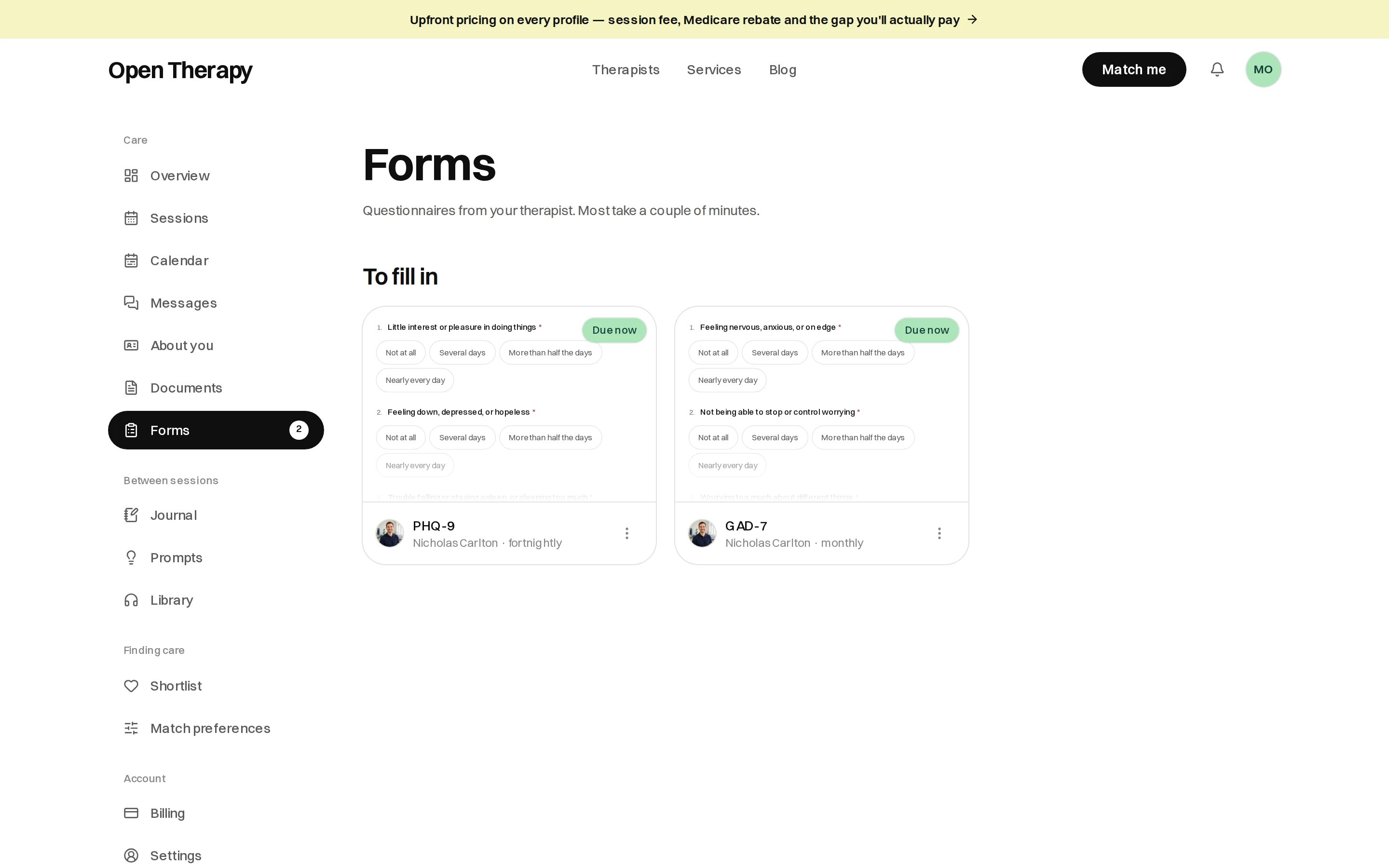 Every question on one page, with a count of how many you've answered.
A partly answered measure won't send. Blank questions are listed and you're taken to the first.
Click **Send it**. Nothing is saved until then.
Reopen anything you've sent to change it; **Save changes** replaces that date's answer.
## Due dates
A form arrives with a cadence: Once, Weekly, Fortnightly, Monthly or Quarterly. Each repeat is its own occurrence with its own date, and past answers stay attached to theirs.
Due dates aren't adjusted to your timezone — a form is due on the same calendar day for you and
for your therapist. Session times always are.
A repeat stays open until the next comes due; a one-off for a week, then reads as overdue. Your therapist can pause or end an assignment: it stops asking, and anything you sent stays.
## If you skip one
No penalty, no chasing, no effect on your bookings.
* The occurrence is recorded as missed, and your therapist can see that it was.
* The next one arrives on schedule.
* Fill in an earlier one from the menu on the card; it fills that gap rather than counting as the new one.
If a form doesn't make sense, tell your therapist rather than guessing.
## Your own scores
Open the menu on a card: **What you've sent** lists the dates you answered with the score beside each — 12 of 27, for instance. Nothing is colour-coded.
Open Therapy doesn't tell you what a score means. A questionnaire score is not a diagnosis, so ask your therapist if one worries you.
## Who sees your answers
The therapist who sent it. If you're seeing more than one therapist on Open Therapy, your measure scores are part of what any of them can read. No other client sees anything.
The **Outcome measures** switch under **What your therapists see** in **Settings** controls how much of a measure they see. It's on by default, and it's all or nothing.
| | |
| ---------- | -------------------------------------------------------------------------------------------------------------------------------- |
| Switch on | Your treating therapists see the same scores you do, with the severity band and the trend |
| Switch off | They still see that they sent you the form and whether you answered. The score, the severity band and any risk flag are withheld |
Some measures include a self-harm question. Answering above zero raises a flag with the therapist who sent it, so a person reads the response. With the switch off, they're told you answered and nothing more.
## If a question brings something up
Open Therapy is a directory and booking platform. A flagged response is emailed to your therapist
to read when they next open their work — nobody is watching answers as they arrive, and a form is
not a way to reach anyone urgently.
If you're in immediate danger, call **000**. To talk to someone now, call **Lifeline** on **13 11
14** or **13YARN** on **13 92 76**, both 24 hours. More services are listed in [Getting
help](/getting-help).
If something in a form is worth talking about before your next session, [message your therapist](/clients/messages). That reaches a person; a form doesn't.
Every question on one page, with a count of how many you've answered.
A partly answered measure won't send. Blank questions are listed and you're taken to the first.
Click **Send it**. Nothing is saved until then.
Reopen anything you've sent to change it; **Save changes** replaces that date's answer.
## Due dates
A form arrives with a cadence: Once, Weekly, Fortnightly, Monthly or Quarterly. Each repeat is its own occurrence with its own date, and past answers stay attached to theirs.
Due dates aren't adjusted to your timezone — a form is due on the same calendar day for you and
for your therapist. Session times always are.
A repeat stays open until the next comes due; a one-off for a week, then reads as overdue. Your therapist can pause or end an assignment: it stops asking, and anything you sent stays.
## If you skip one
No penalty, no chasing, no effect on your bookings.
* The occurrence is recorded as missed, and your therapist can see that it was.
* The next one arrives on schedule.
* Fill in an earlier one from the menu on the card; it fills that gap rather than counting as the new one.
If a form doesn't make sense, tell your therapist rather than guessing.
## Your own scores
Open the menu on a card: **What you've sent** lists the dates you answered with the score beside each — 12 of 27, for instance. Nothing is colour-coded.
Open Therapy doesn't tell you what a score means. A questionnaire score is not a diagnosis, so ask your therapist if one worries you.
## Who sees your answers
The therapist who sent it. If you're seeing more than one therapist on Open Therapy, your measure scores are part of what any of them can read. No other client sees anything.
The **Outcome measures** switch under **What your therapists see** in **Settings** controls how much of a measure they see. It's on by default, and it's all or nothing.
| | |
| ---------- | -------------------------------------------------------------------------------------------------------------------------------- |
| Switch on | Your treating therapists see the same scores you do, with the severity band and the trend |
| Switch off | They still see that they sent you the form and whether you answered. The score, the severity band and any risk flag are withheld |
Some measures include a self-harm question. Answering above zero raises a flag with the therapist who sent it, so a person reads the response. With the switch off, they're told you answered and nothing more.
## If a question brings something up
Open Therapy is a directory and booking platform. A flagged response is emailed to your therapist
to read when they next open their work — nobody is watching answers as they arrive, and a form is
not a way to reach anyone urgently.
If you're in immediate danger, call **000**. To talk to someone now, call **Lifeline** on **13 11
14** or **13YARN** on **13 92 76**, both 24 hours. More services are listed in [Getting
help](/getting-help).
If something in a form is worth talking about before your next session, [message your therapist](/clients/messages). That reaches a person; a form doesn't.