> ## Documentation Index
> Fetch the complete documentation index at: https://docs.opentherapy.app/llms.txt
> Use this file to discover all available pages before exploring further.
# Ask a therapist
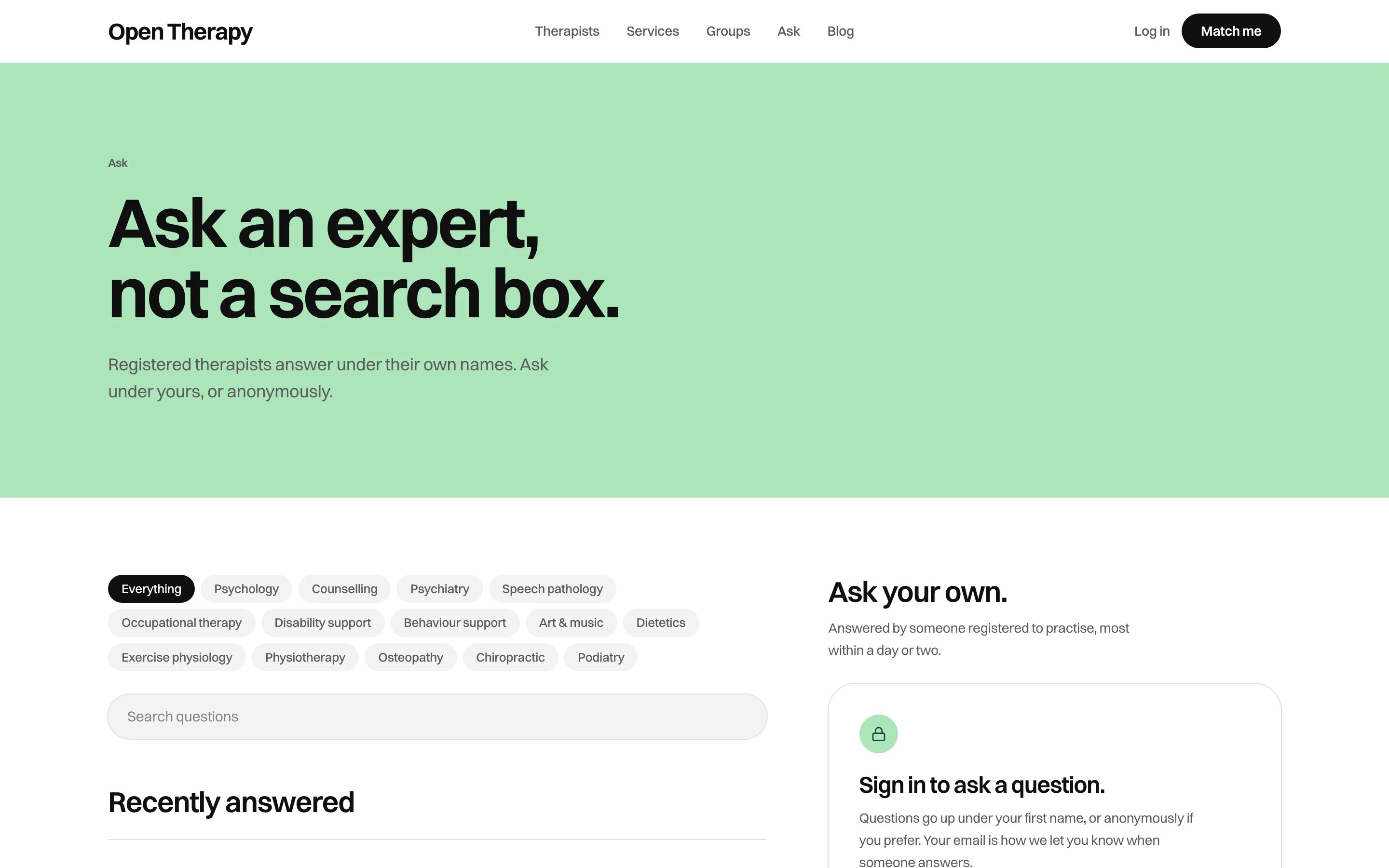
> Asking a question in the public Q&A, and how anonymity and moderation work.
Ask a therapist is being rolled out. You may not see it in the navigation yet.
Ask a therapist is a public library of questions with answers written by therapists on Open Therapy. It's at [opentherapy.app/ask](https://opentherapy.app/ask), and anyone can read it without an account.
Answers are general information, not advice about you. A therapist answering a question has never
met you and can't diagnose anything or tell you what treatment to have. For that, [book a
session](/clients/book-a-session).
If you're in immediate danger, call **000**. To talk to someone now, call **Lifeline** on **13 11
14** or **13YARN** on **13 92 76**, both 24 hours. Other services are listed in [Getting
help](/getting-help).
## Asking a question
You need an account to ask, because your email address is how we tell you when someone answers.
 A title of between 15 and 160 characters — a real question, like "Is it normal to feel worse after the first few sessions?" — and up to 2,000 characters of detail if you want to add any.
Topics are the care categories. The topic decides which therapists are invited to answer, so pick the discipline rather than the mood.
Leave **Ask anonymously** off and it goes up under your first name. Turn it on and it's published with no name and no picture.
Click **Ask**. You can ask two questions an hour.
Your surname is never shown, either way. Neither is your email address, your location, or anything else from your account.
Most care categories aren't live yet — psychology and counselling are the ones with therapists
practising. A question filed under a category still being rolled out may wait a long time for an
answer.
## Leave yourself out of it
Leave out anything that would identify you or somebody else. The page is public and it stays up.
Questions naming a practitioner, identifying a third party, or asking for a medication dose or a diagnosis are turned away. So are questions containing phone numbers, email addresses or links — use [Messages](/clients/messages) to reach someone privately.
## Moderation before publication
Every question is screened before it's published.
| | |
| ----------------- | ------------------------------------------------------------------------- |
| Clearly fine | Published straight away, and the therapists who can answer it are emailed |
| Borderline | Held, and a person reads it. You're told it's being read |
| Against the rules | Not published. You're told why |
Answers are screened the same way, against the same line: general information yes, personal clinical advice no.
If a question reads as somebody in immediate distress, it isn't published and it isn't stored. The form is replaced with crisis services instead.
## Who answers
Therapists with a published, verified listing on Open Therapy, in the discipline the topic maps to. When a question goes up, up to 25 of them are emailed about it; the rest see it waiting in their workspace.
Nobody is assigned and nobody is paid to answer, so some questions get several answers and some get none. A question still unanswered after a week or two is better asked of a therapist directly.
You're emailed when your question is answered. The email names the therapist and links to the page, but doesn't quote the answer.
## Reading and answers
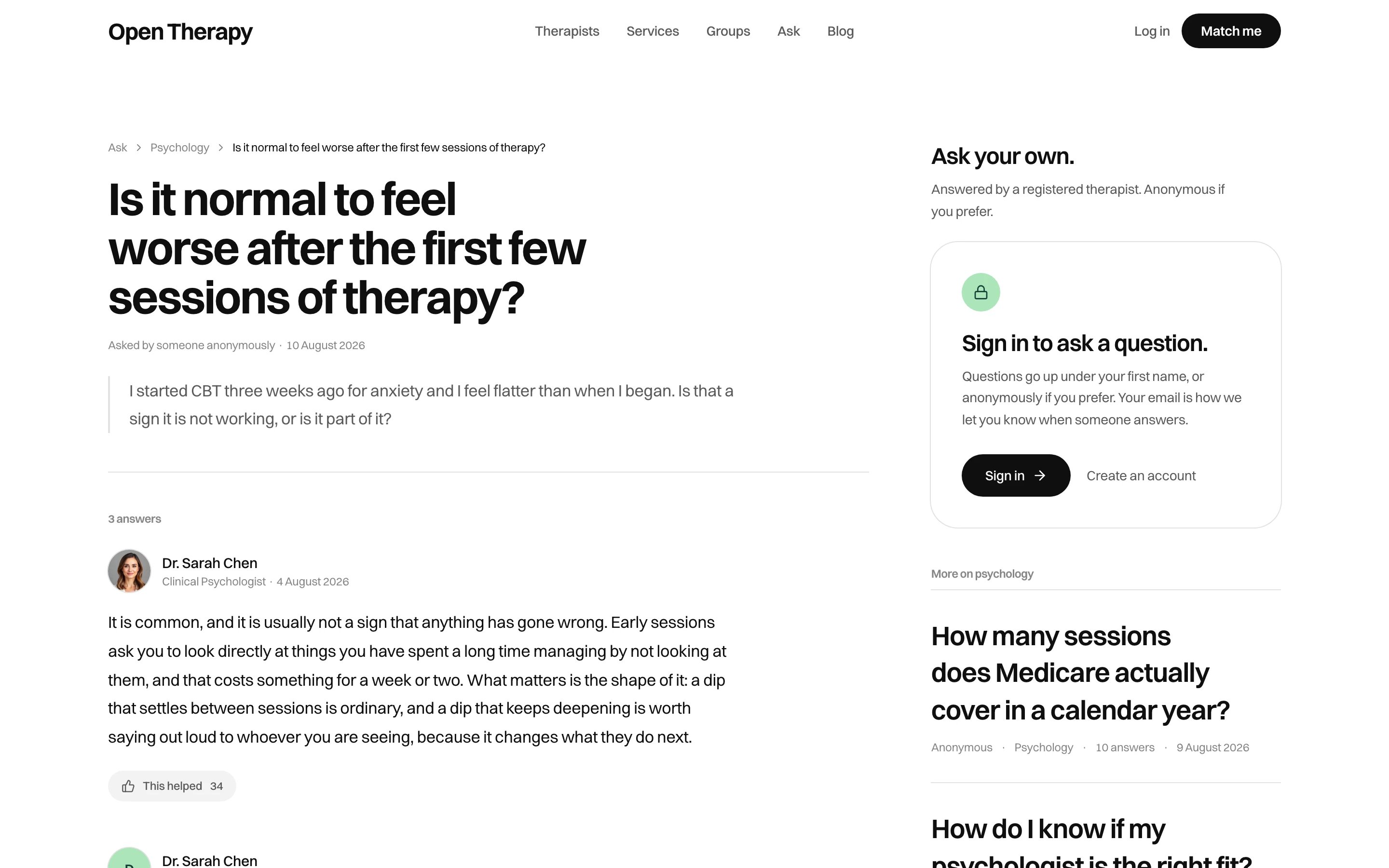
Answers sit under the question, ordered by **This helped** votes. Click it to vote for one.
Related questions in the same topic are listed at the bottom, and you can browse a whole topic at `/ask/topic/psychology` and the like.
A title of between 15 and 160 characters — a real question, like "Is it normal to feel worse after the first few sessions?" — and up to 2,000 characters of detail if you want to add any.
Topics are the care categories. The topic decides which therapists are invited to answer, so pick the discipline rather than the mood.
Leave **Ask anonymously** off and it goes up under your first name. Turn it on and it's published with no name and no picture.
Click **Ask**. You can ask two questions an hour.
Your surname is never shown, either way. Neither is your email address, your location, or anything else from your account.
Most care categories aren't live yet — psychology and counselling are the ones with therapists
practising. A question filed under a category still being rolled out may wait a long time for an
answer.
## Leave yourself out of it
Leave out anything that would identify you or somebody else. The page is public and it stays up.
Questions naming a practitioner, identifying a third party, or asking for a medication dose or a diagnosis are turned away. So are questions containing phone numbers, email addresses or links — use [Messages](/clients/messages) to reach someone privately.
## Moderation before publication
Every question is screened before it's published.
| | |
| ----------------- | ------------------------------------------------------------------------- |
| Clearly fine | Published straight away, and the therapists who can answer it are emailed |
| Borderline | Held, and a person reads it. You're told it's being read |
| Against the rules | Not published. You're told why |
Answers are screened the same way, against the same line: general information yes, personal clinical advice no.
If a question reads as somebody in immediate distress, it isn't published and it isn't stored. The form is replaced with crisis services instead.
## Who answers
Therapists with a published, verified listing on Open Therapy, in the discipline the topic maps to. When a question goes up, up to 25 of them are emailed about it; the rest see it waiting in their workspace.
Nobody is assigned and nobody is paid to answer, so some questions get several answers and some get none. A question still unanswered after a week or two is better asked of a therapist directly.
You're emailed when your question is answered. The email names the therapist and links to the page, but doesn't quote the answer.
## Reading and answers
Answers sit under the question, ordered by **This helped** votes. Click it to vote for one.
Related questions in the same topic are listed at the bottom, and you can browse a whole topic at `/ask/topic/psychology` and the like.
 ## Answers are public and searchable
Every published question has its own page and its own address, and those pages are in the sitemap, meant to be found by search engines. If that isn't comfortable, use **Ask anonymously**, or ask your therapist instead.
A question isn't part of your clinical record. A therapist answering sees the question, the topic, and your first name unless you asked anonymously — not your account, and not anything you've filled in as somebody's client.
## Answers are public and searchable
Every published question has its own page and its own address, and those pages are in the sitemap, meant to be found by search engines. If that isn't comfortable, use **Ask anonymously**, or ask your therapist instead.
A question isn't part of your clinical record. A therapist answering sees the question, the topic, and your first name unless you asked anonymously — not your account, and not anything you've filled in as somebody's client.